---
title: Investment Philosophy - Boyar Research
---
[Skip to content](https://boyarresearch.com/investment-philosophy-boyar-research-old2#main-content)
[](https://boyarresearch.com?hsLang=en)
[](https://boyarresearch.com?hsLang=en)
- [Home](https://boyarresearch.com)
- [Subscriptions](https://boyarresearch.com/boyar-research-subscriptions)
- [Fresh Looks 2026](https://boyarresearch.com/freshlooks2026)
- [Philosophy](https://boyarresearch.com/investment-approach)
- [Investment Approach](https://boyarresearch.com/investment-approach)
- [Research Methodology](https://boyarresearch.com/investment-philosophy-boyar-research)
- [What Makes Boyar Research Unique?](https://boyarresearch.com/unique)
- [Performance](https://boyarresearch.com/performance)
- [Blog](https://www.blog.boyarvaluegroup.com/boyar-value-group-blog)
- [Team](https://boyarvaluegroup-4595129.hs-sites.com/boyar-value-group-team)
- [Request complimentary reports](https://share.hsforms.com/1hypsHKWjSYqQldbERbBP0Q2qhmh)
[Request complimentary reports](https://share.hsforms.com/1hypsHKWjSYqQldbERbBP0Q2qhmh)
This is a search field with an auto-suggest feature attached.
- There are no suggestions because the search field is empty.
# Stock Selection Method
# Stock Selection Method
## Stock Selection **Method**
Exhaustive analysis is at the heart of what we do. Before investing in any company, we thoroughly study a company’s intrinsic or private market value.
Some of our methods for stock selection are detailed below.
## Hidden Asset **Method**
Finding undervalued assets doesn’t happen every day—but it’s always worth looking.
At Boyar Research, we refer to things like real estate and brand equity as “hidden assets” because they’re often understated, obscured, or completely missing from a company’s balance sheet.
One reason? GAAP accounting rules typically require companies to carry assets—such as buildings or land—at historical cost, even if their actual value has risen significantly over time. That makes these assets hard to detect through simple stock screens or a quick glance at the financials.
### How do you Find Hidden Assets?
They’re only uncovered through curiosity, patience, deep reading, and good old-fashioned elbow grease.

In addition to real estate, hidden assets can include:
- Natural resource reserves
- Off-balance-sheet investment holdings
- Brand equities
- Overlooked subsidiaries or business lines
Hidden assets aren’t always visible at first glance—but they can hold significant value.
We’ve been applying this method for decades. In the 1970s, we profiled Stokely-Van Camp, then known mostly for its baked beans. But what intrigued us wasn’t the bean business—it was that the company quietly owned the rights to a fast-growing, little-known sports drink: Gatorade.
Or consider Binney & Smith. In 1979, the name meant little to investors. But it was the maker of Crayola Crayons, a brand found in nearly every American household.
Sometimes, the most valuable part of a business is hiding in plain sight.
## Franchise **Approach**
Great consumer brands are sometimes overlooked, or underappreciated, by the wider market when those brands as "hidden" behind an unassuming corporate name. This approach requires two elements:
1. An iconic brand or franchise, which can offer competitive advantages that are nearly impossible to replicate
2. A corporate name that "masks" this well-known franchise, causing a valuation discrepancy to occur.
In addition, great consumer franchises (even if not masked by a corporate name) that have spent decades building brand equity to consumers which would be either very expensive or impossible to replace are intriguing opportunities for us especially if their stock price goes on sale due to reasons we believe are temporary in nature.
We have found the franchise approach to be an exceedingly effective method of finding unappreciated value.
## Business Value **Method**
Over the long run, stock markets tend to be efficient. But in the short term, valuations can swing wildly—both to the upside and the downside.
These extremes often arise when investors rush into whatever’s in vogue and abandon what’s out of favor. When entire industries fall out of fashion, Wall Street sometimes drives the market caps of companies well below what a strategic acquirer would pay for the whole business.
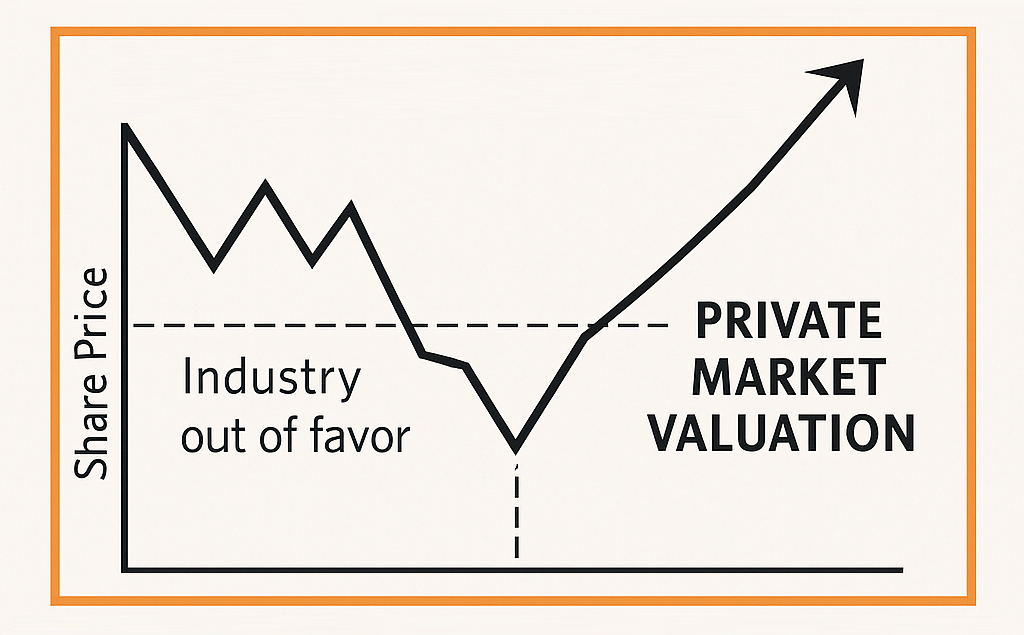
That disconnect creates compelling opportunities for discerning investors with the patience—and conviction—to wait for the market to catch up.
Of course, it’s impossible to predict when the tide will turn. Investors may endure years of underperformance before the payoff arrives. But in our experience, it’s often well worth the wait.
## Why Spinoffs Often Present **Opportunity**
Newly spun-out companies are frequently mispriced for two main reasons:
- **Limited Analyst Coverage**
Many spinoffs receive little to no coverage from Wall Street, making it easier for valuation gaps to persist.
- **Forced Selling by Institutional Holders**
Shareholders of the parent company may be required—due to their investment mandates—to sell shares of the spinout, regardless of fundamentals. For example, the spun-off company might fall outside a fund’s market cap range or industry focus. This can create artificial, short-term selling pressure on the stock price.
However, not all spinoffs are attractive. In some cases, companies use them to offload underperforming or non-core assets onto a new shareholder base.
At Boyar Research, we’ve developed a proprietary framework to help us identify attractive spinoff opportunities while avoiding potential value traps.
## Catalysts
Finding an undervalued company with strong fundamentals is only part of the equation
Without a catalyst, even deeply discounted stocks can remain undervalued for years—sometimes indefinitely.
That’s why we insist on identifying a clear reason why the market might recognize the company’s value within a reasonable time frame—typically two to five years. We’re patient investors, but are mindful of avoiding “value traps.”
We evaluate a range of potential catalysts, including:
- The initiation (or significant increase) of a dividend or a meaningful share repurchase program
- A corporate restructuring, such as a spin-off or business separation
- Management changes, industry consolidation, or signs of an operational turnaround
- Ownership by an aging founder or CEO without a clear succession plan
We’re not just looking for value—we’re looking for value that has a reason to be unlocked.
## Avoiding **Value Traps**
One of the biggest risks in value investing is falling into a value trap.
A value trap is a stock that appears undervalued based on traditional metrics (like P/E or P/B), but remains cheap—or declines further—because the company’s underlying fundamentals are deteriorating or show no signs of improvement. In other words, the stock is cheap for a reason.
This often happens when an entire industry or group of stocks falls out of favor—sometimes due to a perceived (and sometimes real) threat—and trades down to bargain-basement levels as investors flee. These situations can lure value investors into what seem like attractive opportunities. But the key is determining whether the stock is truly undervalued—or just cheap for a reason.
Here are some questions we ask ourselves to help make that distinction:
1. Is the industry going the way of the buggy whip?
2. Does this business still have a reason to exist?
3. Is the company overleveraged, or can it survive a downturn?
4. Is new competition eroding its competitive position?
5. Is the product still in demand—or have consumer tastes moved on permanently?
If you can confidently answer yes to some or all of these questions, the chances of stepping into a value trap diminish (though they’re never eliminated entirely).
### The Bottom Line
Many screens can point you to industries or stocks that have fallen out of favor. But the real work lies in understanding why they’ve declined—and whether the issue is temporary and fixable or permanent and structural.
Armed with that knowledge, the willingness to go against the crowd, and the patience to wait for value to be recognized, you can uncover opportunities to buy proverbial fifty-cent dollars—without falling into the trap.

#### Quick Links
- [Hidden Asset Method](https://boyarresearch.com/investment-philosophy-boyar-research-old2#menu-01)
- [Franchise Approach](https://boyarresearch.com/investment-philosophy-boyar-research-old2#menu-02)
- [Business Value Method](https://boyarresearch.com/investment-philosophy-boyar-research-old2#menu-03)
- [Special Situations](https://boyarresearch.com/investment-philosophy-boyar-research-old2#menu-04)
- [Catalysts and Triggers](https://boyarresearch.com/investment-philosophy-boyar-research-old2#menu-05)
- [Avoiding Value Traps](https://boyarresearch.com/investment-philosophy-boyar-research-old2#menu-06)
#### Social Links

### Facebook

### Twitter

### Linkedin
## How can **we help?**

Since 1975 the Boyar family of companies has focused on creating value for our clients — by seeking out and investing in companies whose intrinsic value significantly exceeds that of its current market price.
##### Social Links

### Facebook

### Linkedin

### Twitter
##### Contact us

### info@boyarvaluegroup.com
[mailto:info@boyarvaluegroup.com](mailto:info@boyarvaluegroup.com)

### (212) 995-8300

### 667 Madison Avenue, 5th floor New York, NY 10065
##### Newsletter
[Subscribe To Our Substack](https://boyarresearch.substack.com/)
© 2026 Boyar's Intrinsic Value Research LLC. All rights reserved.
```json
{
"@context" : "https://schema.org",
"@type" : "VideoObject",
"contentUrl" : "https://39755870.fs1.hubspotusercontent-na1.net/hubfs/39755870/Finding%20attractive%20opportunities%20(final)-1.m4v",
"dateModified" : "2023-08-14T13:54:03.879Z",
"duration" : "PT50S",
"height" : 360,
"name" : "Finding attractive opportunities (final)-1",
"thumbnailUrl" : "https://39755870.fs1.hubspotusercontent-na1.net/hubfs/39755870/Finding%20attractive%20opportunities%20(final)-1.m4v/medium.jpg",
"uploadDate" : "2023-08-14T13:53:57.497Z",
"width" : 640
}
```
```json
{
"@context" : "https://schema.org",
"@type" : "VideoObject",
"contentUrl" : "https://39755870.fs1.hubspotusercontent-na1.net/hubfs/39755870/Hiden%20Asset%20Approach%20(final).m4v",
"dateModified" : "2023-08-18T16:08:40.677Z",
"duration" : "PT1M25.533S",
"height" : 1080,
"name" : "Hiden Asset Approach (final)",
"thumbnailUrl" : "https://39755870.fs1.hubspotusercontent-na1.net/hubfs/39755870/Hiden%20Asset%20Approach%20(final).m4v/medium.jpg",
"uploadDate" : "2023-08-09T02:30:51.287Z",
"width" : 1920
}
```
```json
{
"@context" : "https://schema.org",
"@type" : "VideoObject",
"contentUrl" : "https://39755870.fs1.hubspotusercontent-na1.net/hubfs/39755870/Franchise%20Approach%20(final).m4v",
"dateModified" : "2023-08-18T16:09:25.264Z",
"duration" : "PT1M27.737S",
"height" : 1080,
"name" : "Franchise Approach (final)",
"thumbnailUrl" : "https://39755870.fs1.hubspotusercontent-na1.net/hubfs/39755870/Franchise%20Approach%20(final).m4v/medium.jpg",
"uploadDate" : "2023-08-09T02:30:52.017Z",
"width" : 1920
}
```
```json
{
"@context" : "https://schema.org",
"@type" : "VideoObject",
"contentUrl" : "https://39755870.fs1.hubspotusercontent-na1.net/hubfs/39755870/Business%20Value%20Method%20(Final).m4v",
"dateModified" : "2023-08-18T16:10:00.480Z",
"duration" : "PT1M17.321S",
"height" : 1080,
"name" : "Business Value Method (Final)",
"thumbnailUrl" : "https://39755870.fs1.hubspotusercontent-na1.net/hubfs/39755870/Business%20Value%20Method%20(Final).m4v/medium.jpg",
"uploadDate" : "2023-08-09T02:30:47.079Z",
"width" : 1920
}
```